Sound Baths in Kelowna: What to expect and why it works
Something has shifted in Kelowna's wellness scene over the last few years. Travellers who once booked back-to-back spa treatments are now choosing to spend 60 minutes lying completely still on a mat while someone plays crystal bowls a few feet away. And they're leaving differently: quieter, slower, noticeably reset. Sound baths have moved from fringe curiosity to a genuine retreat anchor in the Okanagan, and the reasons are worth understanding.
A sound bath is a passive, immersive experience where resonant instruments guide your nervous system into deep relaxation. You don't do anything. You just receive the sound. No poses, no breathwork required, no prior experience necessary. What happens inside that session, though, is more layered than it looks from the outside.
This article covers exactly what happens during a sound bath session, what the research actually supports (and where it falls short), who should hold off, and how to access a vetted practitioner in Kelowna without the usual coordination headache.
What actually happens inside a sound bath session
The instruments doing the work
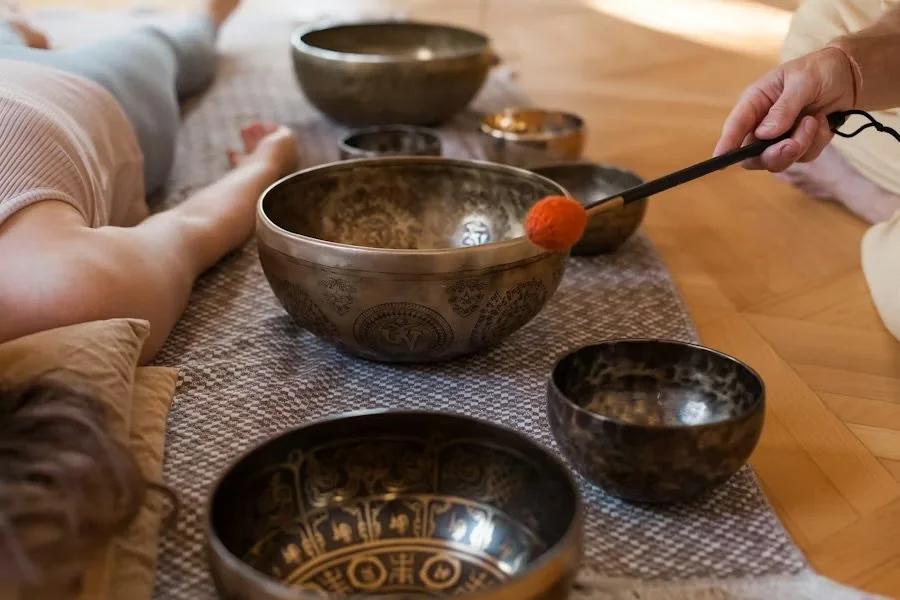
A typical session uses three to five instruments, each chosen for a specific function. Crystal singing bowls produce clear, sustained tones and are the most familiar instrument in the format. Symphonic gongs produce broad harmonic overtones across the full frequency spectrum — more wave than note. Chimes deliver lighter, higher-frequency tones used for transitions. Tuning forks, calibrated to specific pitches, can be applied to or near the body for targeted vibrational work.
The goal is to layer frequencies that shift brainwave state from beta (active, thinking) toward alpha, theta, and sometimes delta (deep rest, bordering on sleep).
How a session flows from start to finish
Sessions follow a three-phase structure. The first 5 to 15 minutes are preparation: you settle onto a mat with blankets and bolsters, the practitioner may guide brief breathwork or invite you to set an intention, and the room quiets. The main immersion follows, ranging from 30 to 75 minutes depending on the format and where the instruments are played, during which participants simply lie still and receive. Group sound baths never involve instruments placed directly on the body; that contact work belongs in one-on-one therapeutic contexts.
The closing integration phase runs 5 to 10 minutes of silence, followed by a gentle return to awareness. No one rushes you to sit up. Full sessions typically run 60 to 90 minutes, with shorter 20 to 30 minute formats common for first-timers. The brainwave shift usually kicks in around the 10- to 15-minute mark, when most people stop bracing and genuinely drop into something that resembles deep restorative rest.

What the research actually says about sound bath benefits
Stress and anxiety: where the evidence is strongest
This is where the science is clearest. A Tibetan singing bowl session with 62 participants produced significant reductions in tension, anxiety, and depressed mood across multiple validated scales, with first-time participants showing the strongest effects. A separate 12-minute Himalayan bowl session before relaxation lowered blood pressure and heart rate compared to silence alone. A 2024 systematic review synthesizing 14 quantitative studies found consistent patterns: reduced anxiety and depressive symptoms, improved well-being, decreased heart rate, and increased delta and theta brainwave activity across diverse populations.
These are real findings. They are also mostly small studies with short follow-up windows and no standardized protocol. The immediate post-session effects are measurable and consistent. Long-term evidence simply doesn't exist, at least not yet.
Sleep, focus, and emotional regulation: promising but preliminary
The proposed mechanism is brainwave entrainment: as the nervous system follows the sustained frequencies from the instruments, beta activity drops and alpha and theta states become dominant — a shift confirmed in EEG studies. Participants across multiple studies and practitioner settings consistently report improved sleep quality following sessions, along with greater mental clarity and occasional emotional releases during or immediately after sessions.
These are consistent patterns supported by plausible neuroscience, but sleep-specific clinical trials haven't yet confirmed them. The mechanism is grounded, the personal reports are credible, and the clinical confirmation is still pending.
What your body and mind experience during a sound bath
Physical sensations to expect
Most people feel a warm heaviness spreading through their limbs within the first 15 minutes. Depending on your proximity to the instruments, you may notice vibrations in your chest or skull, occasional tingling in the extremities, or a slowing of breath that feels involuntary rather than controlled. Some people fall asleep. Others feel a release of pressure in areas of chronic tension, particularly the jaw, shoulders, and upper back. Post-session effects can last anywhere from a few hours to several days.
Minds wander constantly, especially early in the session. That's not a failure of the practice. The only instruction is to return attention to the sound when you notice you've drifted, the same instruction as basic meditation. There is nothing to achieve during a sound bath. That's actually the point.
For helpful background on how sound therapy works and who may benefit, see an overview from UCLA that summarizes current thinking about sound therapy and its potential health benefits.
Practical prep and what to know before you go
Drink at least 8 glasses of water on the day of the session. Wear loose, comfortable clothing you'd be happy lying in for an hour. If the venue doesn't provide blankets and eye pillows, bring your own. Arrive 10 minutes early so you're not rushing into a space designed for stillness. After the session, a short journal entry or a quiet walk helps integrate whatever surfaced, rather than immediately jumping back into phone notifications.
Who should hold off (and what to tell your practitioner first)
Contraindications that matter
Sound baths are accessible to most people, but a few groups should consult a medical professional before attending. People with epilepsy, pacemakers, or other electronic implants should get clearance from their doctor, as strong vibrational frequencies can interfere with implanted devices or trigger neurological responses. Pregnant women are generally advised to avoid sessions involving gongs or high-intensity instruments, particularly in the first trimester. Those with severe tinnitus may find sustained tones aggravating rather than relaxing — a practitioner who knows in advance can adjust instrument selection and volume accordingly. People currently experiencing acute psychiatric episodes or severe dissociation should hold off until they're in a more stable place, as the altered states a sound bath can induce may be disorienting rather than grounding.
None of these are reasons to avoid sound baths permanently — they're reasons to have a conversation with your physician first.
Questions to ask your practitioner before a session
Ask directly: Will instruments be placed on my body in this session? (The answer should be no in group settings.) What training or certification do you hold, and with which organization? How do you handle a participant who feels overwhelmed mid-session? Do you have experience working with clients who have a specific condition you're managing? Any practitioner who deflects these questions is worth approaching cautiously. Good practitioners welcome them and routinely offer accommodations, such as distance from instruments or modified positioning, for sensitive attendees.
Private sound baths in Kelowna through Sunset House Vacation Rental
The key variables are honest expectations and a practitioner who knows what they're doing. For anyone spending time in the Okanagan, Wellness in Kelowna at Sunset House makes private sound baths as seamless as they get.
One thing worth knowing for longer stays this summer (June through September): stays of four nights or more include a complimentary sunset yoga and sound bath session on the patio. It's become one of those things guests mention long after they've left.